A business website is often the first place where potential customers interact with your brand. Within seconds, visitors decide whether your business appears professional, trustworthy, and capable of meeting their needs. While many people use the terms website design and website development interchangeably, they are two distinct disciplines that work together to create a successful website.
A visually attractive website may capture attention, but without proper development, it can suffer from slow loading speeds, broken functionality, and poor user experience. Similarly, a technically robust website with an outdated or confusing design may struggle to engage visitors and generate leads.
This is why investing in professional website services is essential. Businesses need both creative design and reliable development to deliver an exceptional user experience, strengthen their online presence, and support long-term growth.
Let’s explore the differences and understand why both play an equally important role.
Understanding Website Design
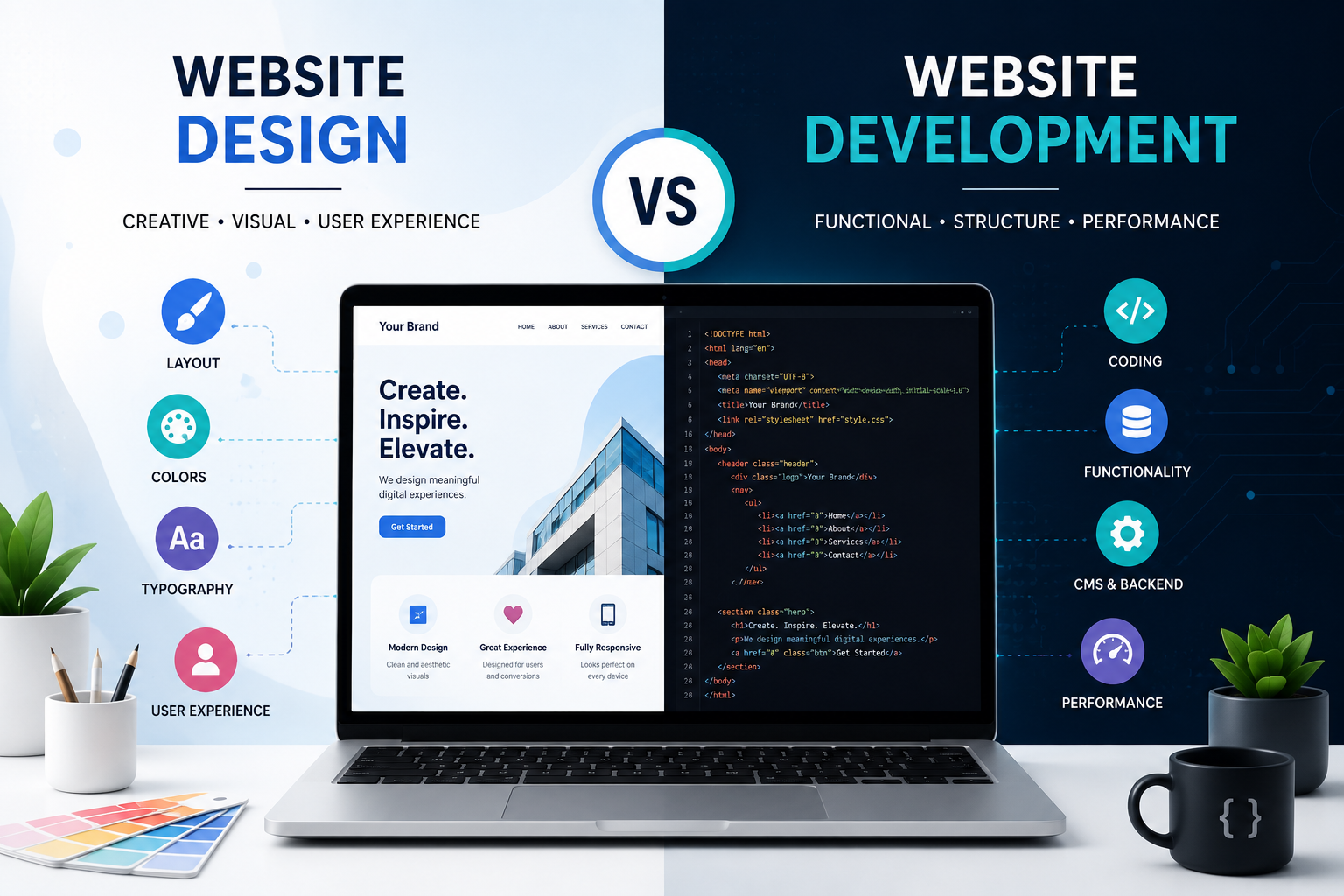
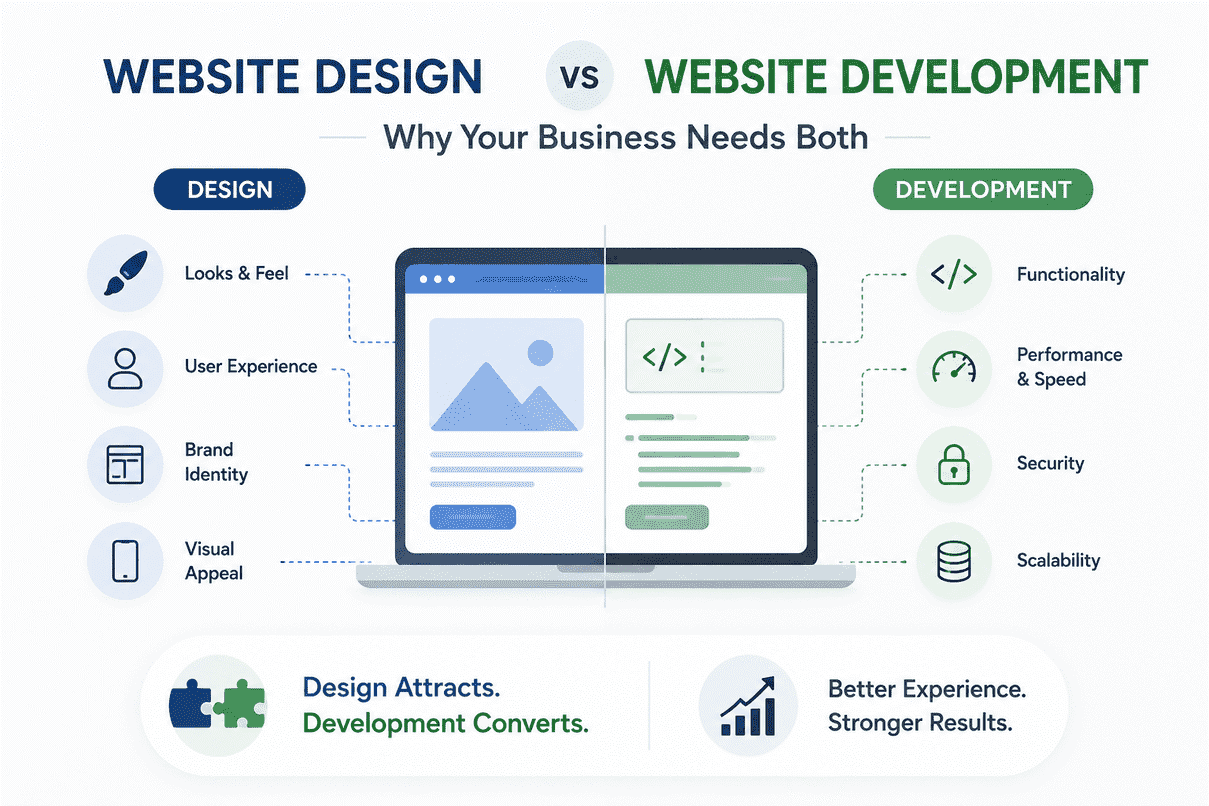
Website design focuses on everything users see and experience when they visit a website. It combines creativity with usability to ensure visitors enjoy a smooth and engaging journey.
A well-designed website should communicate your brand identity while making it easy for users to find information and take action.
Website design includes:
- User Interface (UI) design
- User Experience (UX) planning
- Page layouts
- Typography
- Colour schemes
- Images and graphics
- Navigation structure
- Mobile responsiveness
The primary objective of website design is to create an experience that feels intuitive, visually appealing, and aligned with your business goals.
For example, a professional service provider should have a clean, modern website that builds trust, while an ecommerce business requires a design that encourages product discovery and purchases.
Understanding Website Development
If design determines how a website looks, development determines how it works.
Website development transforms design concepts into a fully functional website using programming languages, frameworks, and content management systems.
Development ensures every feature performs smoothly across different browsers and devices.
Website development typically includes:
- Front-end development
- Back-end development
- Database integration
- Website security
- Performance optimisation
- Content Management System (CMS) implementation
- Ecommerce functionality
- API integrations
A professionally developed website is fast, secure, scalable, and capable of supporting future business growth.
Without proper development, even the most attractive website may experience technical issues that negatively impact user experience and search engine rankings.
Website Design vs Website Development
Although they work together, website design and development serve different purposes.
| Website Design | Website Development |
| Focuses on appearance and user experience | Focuses on functionality and performance |
| Creates layouts and visual identity | Builds the website using code and technology |
| Improves usability | Ensures smooth functionality |
| Enhances customer engagement | Optimises speed, security, and scalability |
| Supports branding | Supports technical performance |
The most successful websites combine both disciplines to deliver an experience that is visually appealing and technically reliable.
Why Businesses Need Both
Some businesses invest heavily in beautiful website designs but overlook technical performance. Others prioritise development while neglecting user experience.
Neither approach delivers the best results.
A successful business website depends on the perfect balance between design and development.
Together they help businesses:
- Create strong first impressions
- Improve customer engagement
- Increase enquiry and conversion rates
- Enhance website performance
- Support SEO efforts
- Build long-term customer trust
At DigiSparsh, every website project begins by understanding business objectives before moving into design and development. This ensures that every visual element and every technical component work together to support measurable business outcomes rather than simply creating an attractive website.
Better Design Improves User Experience
Visitors should never have to struggle to navigate your website.
Good design helps users quickly understand:
- Who you are
- What you offer
- How to contact you
- Why they should choose your business
Clear layouts, readable typography, intuitive navigation, and strategically placed calls-to-action encourage visitors to stay longer and explore more pages.
When user experience improves, businesses often see higher engagement and lower bounce rates.
Better Development Improves Performance
Website performance directly influences both customer satisfaction and search engine visibility.
Professional development ensures your website:
- Loads quickly
- Functions correctly on every device
- Remains secure
- Handles increasing traffic
- Supports future upgrades
These technical improvements contribute to a smoother customer experience while also supporting better SEO performance.
At DigiSparsh, development is never treated as an afterthought. We build websites that are designed to grow alongside your business, making future enhancements easier without compromising speed or reliability.
Design and Development Work Together to Improve SEO
Many businesses assume SEO begins only after a website is launched.
In reality, SEO starts during the planning and development stages.
A well-designed and professionally developed website supports SEO through:
- Mobile-friendly layouts
- Fast loading speeds
- Clean site architecture
- Easy navigation
- Optimised code
- Improved Core Web Vitals
These elements help search engines understand your website while also providing a better experience for visitors.
Businesses investing in comprehensive website design and development services often build a stronger foundation for long-term organic growth than those focusing on design or development alone.
FAQs
What is the difference between website design and website development?
Website design focuses on the appearance and user experience, while website development builds the functionality that makes the website work efficiently.
Do businesses need both website design and development services?
Yes. Design attracts visitors and builds trust, while development ensures the website performs well, remains secure, and supports future growth.
Can a well-designed website improve SEO?
Yes. Responsive design, intuitive navigation, and a positive user experience all contribute to better SEO performance alongside technical optimisation.
How often should a business redesign or redevelop its website?
Most businesses should evaluate their website every 2-4 years or whenever it no longer supports business goals, technology standards, or customer expectations.
What should businesses look for in website design and development services?
Look for expertise in UI/UX, responsive design, performance optimisation, SEO best practices, security, scalability, and post-launch support.
How does DigiSparsh help businesses build better websites?
DigiSparsh delivers complete website design and development services by combining creative design, user-focused experiences, robust development, SEO-friendly architecture, and scalable solutions that help businesses generate leads and grow online.