SEO isn’t dead. Search has expanded.
The way people discover information online is changing.
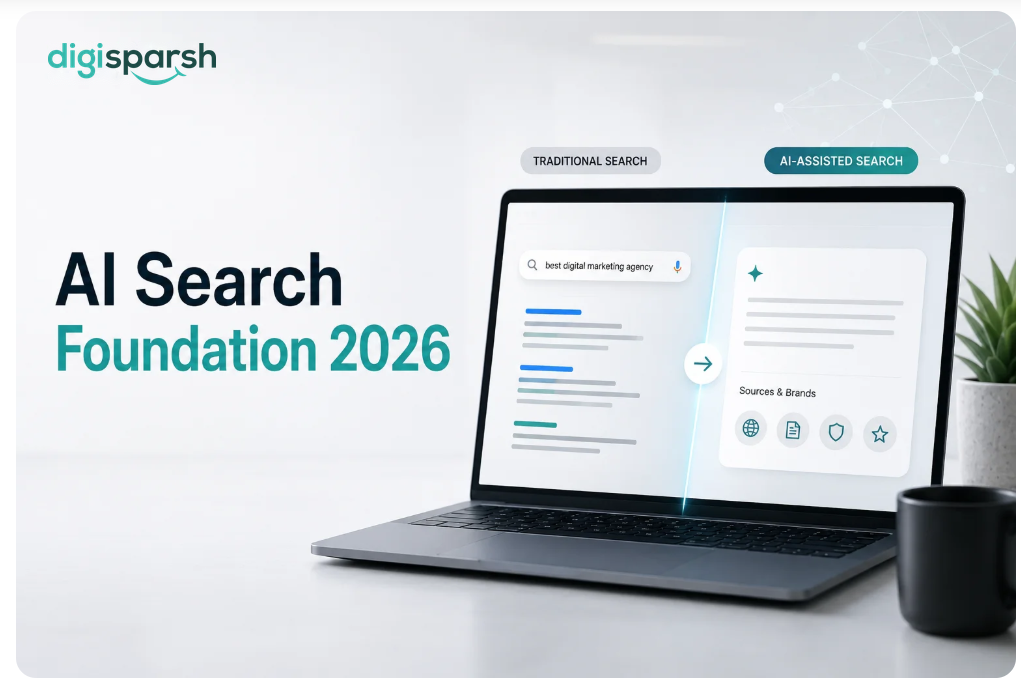
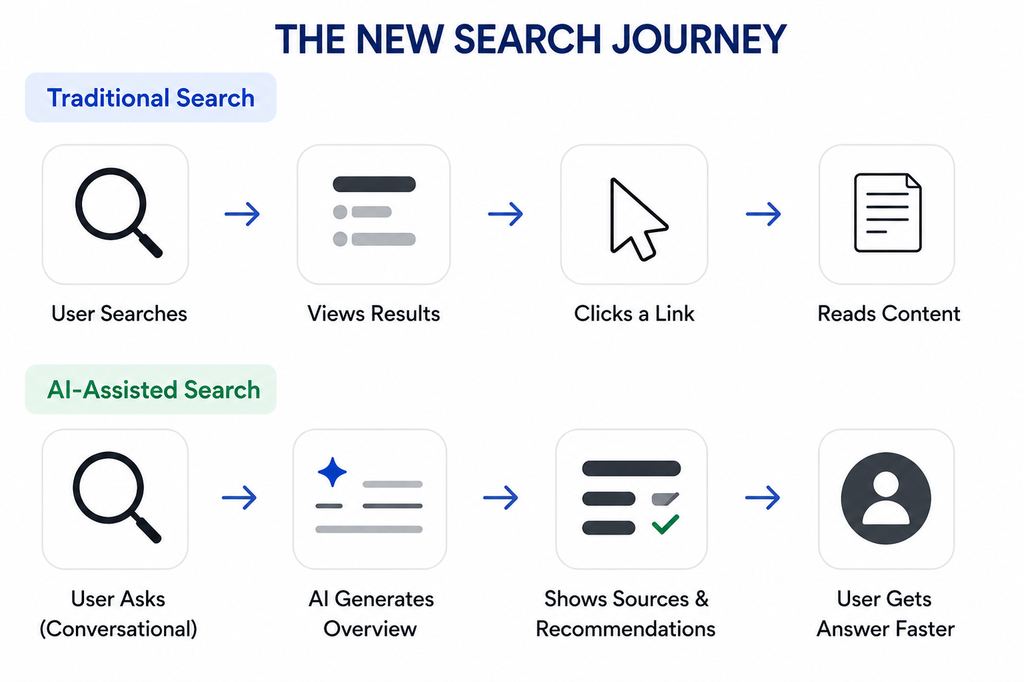
For years, the traditional search journey was straightforward: a user searched Google, reviewed the results, clicked on a website and continued their research there.
That journey is becoming more complex.
Today, users can ask Google AI Overviews, Google AI Mode, ChatGPT, Gemini, Perplexity and other AI-powered platforms questions in a conversational way. Instead of simply receiving a list of links, they can receive a synthesized answer, recommendations, comparisons and sources.
This is changing the discovery layer of the customer journey.
For marketers, this creates a new question:
Is it enough for your website to rank, or does your brand also need to be discoverable within AI-generated answers?
The answer is increasingly both.
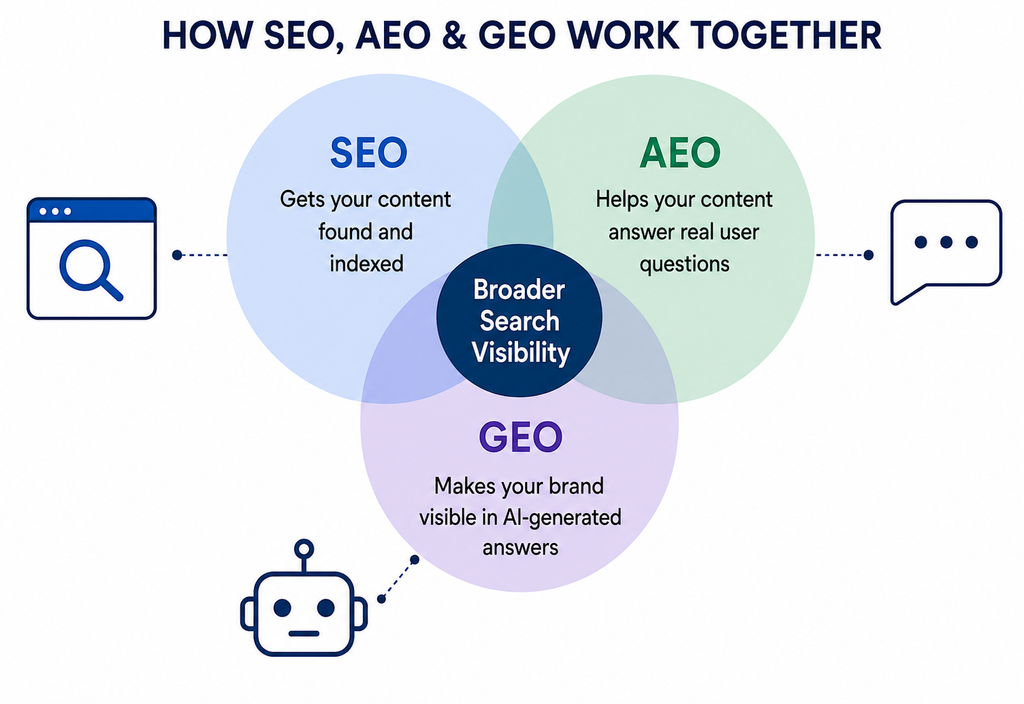
SEO remains the foundation. AEO helps brands become more answer-focused. GEO focuses on visibility within generative AI experiences.
Together, they form a broader approach to modern search visibility.
The New Era of Search Is Already Here
AI-powered search is no longer an experimental side feature.
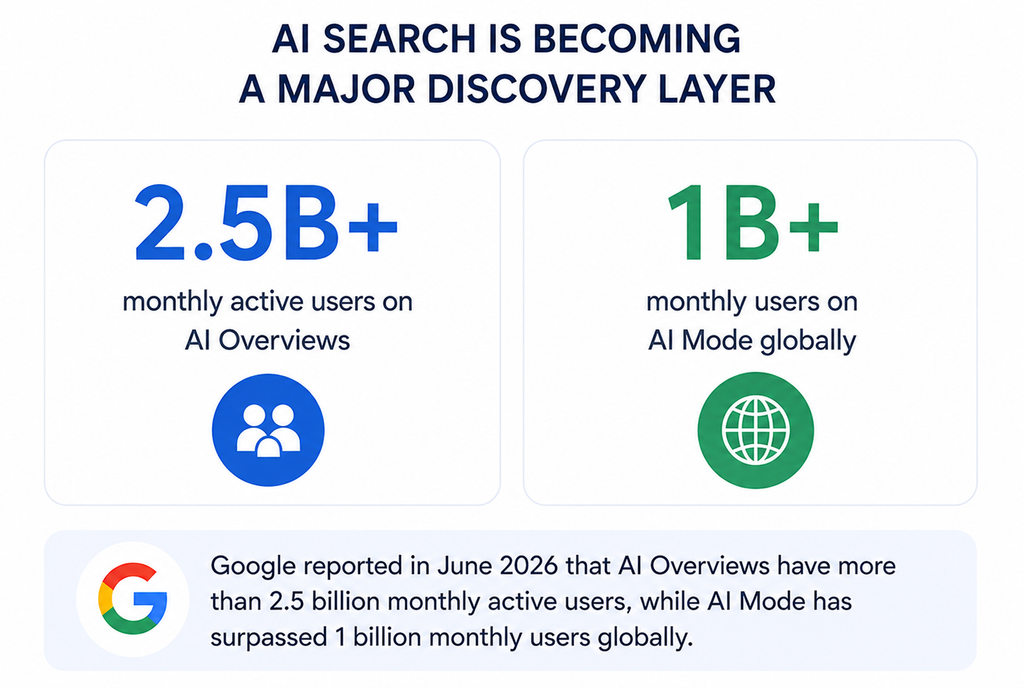
Google reported in June 2026 that AI Overviews now have more than 2.5 billion monthly active users, while AI Mode has surpassed 1 billion monthly users globally. Google also says people are asking Search entirely new kinds of questions through these experiences, creating new opportunities for brands, publishers and creators.
This is an important shift for marketers.
Search is becoming more conversational, exploratory and capable of handling complex questions.
A user may no longer search only:
“best digital marketing agency”
They might ask:
“What should a B2B company look for when choosing a digital marketing agency?”
The second query contains more context and requires a more comprehensive answer.
That is where SEO, AEO and GEO begin to work together.
SEO Is Still the Foundation
Before discussing AEO and GEO, one point needs to be made very clearly:
SEO has not disappeared.
Google’s official guidance explains that its generative AI features are rooted in its core Search systems and that established SEO practices remain relevant for AI experiences.
This means technical accessibility, crawlability, indexability, useful content, website structure, internal linking, relevance and authority continue to matter.
So rather than thinking:
SEO → AEO → GEO → SEO is dead
think:
SEO → AEO + GEO → Broader Search Visibility
SEO remains the foundation on which the newer search strategies are built.
SEO vs AEO vs GEO: What’s the Difference?
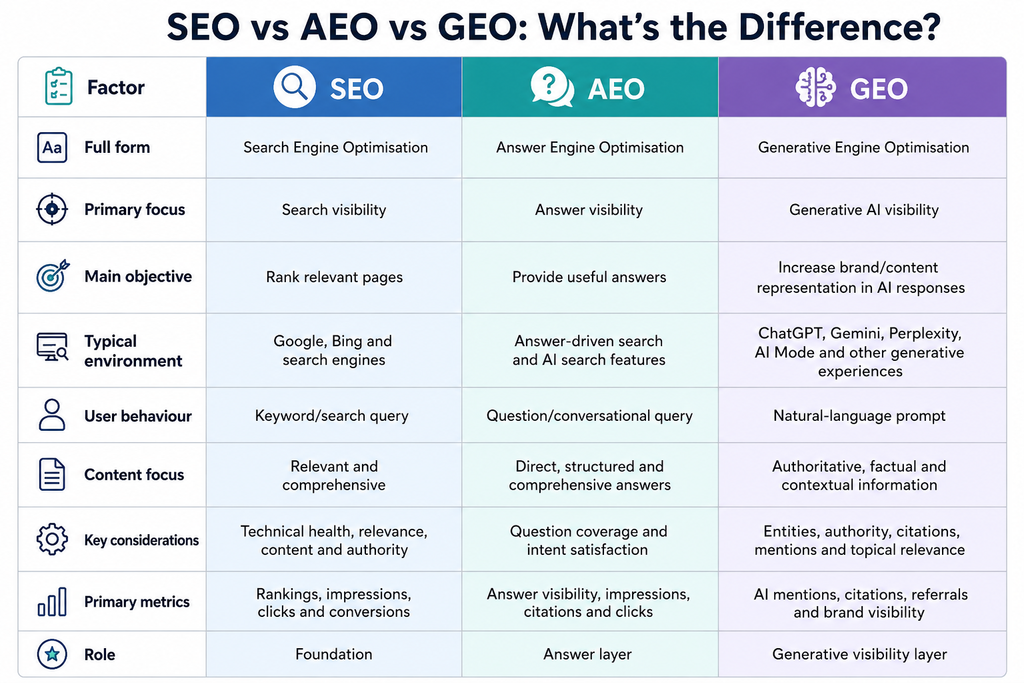
The simplest way to remember it:
SEO = Be discoverable.
AEO = Be answerable.
GEO = Be referenced in generative experiences.
The Data: AI Search Is Becoming a Major Discovery Layer
The shift toward AI-powered search is no longer theoretical.
Google reported in June 2026 that AI Overviews have more than 2.5 billion monthly active users, while AI Mode has surpassed 1 billion monthly users.
Google also says that when people use its AI-powered Search features, they are using Search more, and that AI is enabling people to ask new types of questions.
This does not mean AI has replaced traditional search.
It means the search experience is expanding.
And Google has taken another significant step: in June 2026, it launched Search Generative AI performance reports in Search Console.
These reports provide dedicated visibility into how websites appear within generative AI features such as AI Overviews and AI Mode, including information about impressions, pages, countries, devices and dates.
That changes the conversation for marketers.
AI visibility is moving from:
“I think my brand appears in AI.”
to:
“I can measure my website’s visibility within Google’s generative AI experiences.”
The Marketing Funnel Hasn’t Disappeared — Discovery Has Changed
The traditional marketing funnel is commonly represented as:
TOFU → MOFU → BOFU
TOFU — Awareness
The user identifies a problem and starts researching.
MOFU — Consideration
The user compares possible solutions.
BOFU — Decision
The user evaluates providers and prepares to make a decision.
AI doesn’t necessarily eliminate this funnel.
Instead, it changes where and how discovery happens inside it.
A potential customer might begin TOFU research through:
Google → ChatGPT → Gemini → Perplexity → Reddit → YouTube
They may then visit a company’s website, compare alternatives, read reviews and eventually make a decision.
The funnel remains.
The discovery layer has become more distributed.
This is why modern search strategy needs to consider more than rankings alone.
Why Brand Visibility Beyond Google Matters
A brand can no longer assume that every customer begins their research with a traditional Google query.
People can discover information through:
- Google Search
- AI Overviews
- AI Mode
- ChatGPT
- Gemini
- Perplexity
- YouTube
- Quora
- Industry publications
- Review platforms
- News websites
- PodcastsOnline communities
This creates a broader definition of search visibility.
The question is no longer only:
“Where does my website rank?”
It is also:
“Where does my brand appear when potential customers research the problems, products and services related to my business?”
How to Build an Integrated SEO + AEO + GEO Strategy
1. Build the SEO Foundation
Start with:
- Technical SEO
- Crawlability
- Indexability
- Website architecture
- Keyword mapping
- Search intent
- Internal linking
- Core service pages
- Content quality
- Page experience
- Authority building
AEO and GEO should strengthen the SEO foundation, not replace it.
2. Research Real Questions
Move beyond keyword-volume research.
Find the questions customers actually ask.
Research them through:
- Google Search
- People Also Ask
- Quora
- YouTube
- Customer conversations
- Reviews
- Industry forums
- Search Console
- Sales questions
- Customer support queries
Then turn these questions into content opportunities.
3. Build Topic Clusters
One article shouldn’t exist in isolation.
Create a central topic and support it with related content.
For example, if DigiSparsh wants to build authority around AI SEO, the topic cluster could include:
AI SEO
→ AEO
→ GEO
→ AI Overviews
→ AI Mode
→ LLM visibility
→ AI citations
→ AI search behaviour
→ AI content strategy
→ Entity SEO
→ Topical authority
→ AI search measurement
→ SEO vs GEO
→ AI search analytics
The objective is to demonstrate depth rather than simply publish volume.
4. Create People-First, Evidence-Based Content
AI search does not mean creating content only for machines.
Content should still be useful to people.
Focus on:
- Expert insights
- First-hand experience
- Statistics
- Case studies
- Comparisons
- Examples
- Clear explanations
- Reliable external sources
The goal is:
Human-first content that is also easy for search and AI systems to understand.
5. Build Topical Authority and Brand Presence
GEO extends beyond your website.
A brand’s reputation exists across the wider web.
Build a consistent and credible presence through:
- Industry publications
- Digital PR
- Expert contributions
- Original research
- Reviews
- Relevant directories
- YouTube
- Podcasts
- Industry partnerships
- Third-party references
The objective is not to manufacture mentions.
It is to build genuine evidence that your brand has expertise in its subject.
6. Measure More Than Rankings
A modern search strategy should measure traditional and AI visibility together.
| SEO | AEO | GEO |
|---|---|---|
| Rankings | Question visibility | AI brand mentions |
| Impressions | Answer visibility | AI citations |
| Clicks | AI Overview appearances | AI referrals |
| CTR | Citations | Generative AI impressions |
| Organic traffic | Query coverage | Brand searches |
| Conversions | — | AI-assisted conversions |
Google’s new Search Console reporting is an important step toward measuring visibility within its generative AI search experiences.
Where DigiSparsh Comes In
This is where DigiSparsh’s approach moves beyond traditional SEO.
With 10+ years of digital marketing experience and experience working across different industries and business objectives, DigiSparsh approaches search as an integrated visibility strategy, rather than simply a ranking exercise.
The objective isn’t to chase every new AI platform.
It is to build a strong, authoritative and useful digital presence that can be discovered across the modern search ecosystem.
Frequently Asked Questions
Is SEO dead in 2026?
No. SEO remains the foundation of search visibility. Google’s guidance explains that its generative AI search experiences are rooted in core Search systems, meaning established SEO practices continue to matter.
How long does it take for an SEO, AEO and GEO strategy to show results?
There is no fixed timeline. Results depend on the website’s existing authority, technical health, content quality, industry competition and the scope of the strategy. Technical improvements may produce changes sooner, while building topical authority, organic rankings and AI visibility generally requires consistent work over time.
Is AEO the same as GEO?
No. AEO primarily focuses on answering user questions, while GEO focuses more broadly on brand and content visibility within generative AI experiences. The two strategies overlap and can work together.
Does GEO replace SEO?
No. GEO should complement SEO rather than replace it. Google’s own guidance continues to emphasise the importance of foundational Search practices for AI experiences.
Can businesses measure AI search visibility?
Yes. Google launched Search Generative AI performance reports in Search Console in June 2026. The reports provide dedicated visibility into impressions from generative AI features such as AI Overviews and AI Mode.
How can DigiSparsh help with SEO, AEO and GEO?
DigiSparsh takes an integrated approach to search visibility by combining SEO, AEO and GEO rather than treating them as completely separate strategies. The approach includes SEO foundations, search-intent research, topic clusters, answer-focused content, internal linking, authority building, entity optimisation and strategies designed to strengthen visibility across AI-powered search experiences.