When someone needs a product or service, Google is often one of the first places they turn to. For businesses, this creates an important opportunity: getting in front of potential customers at the exact moment they are looking for a solution.
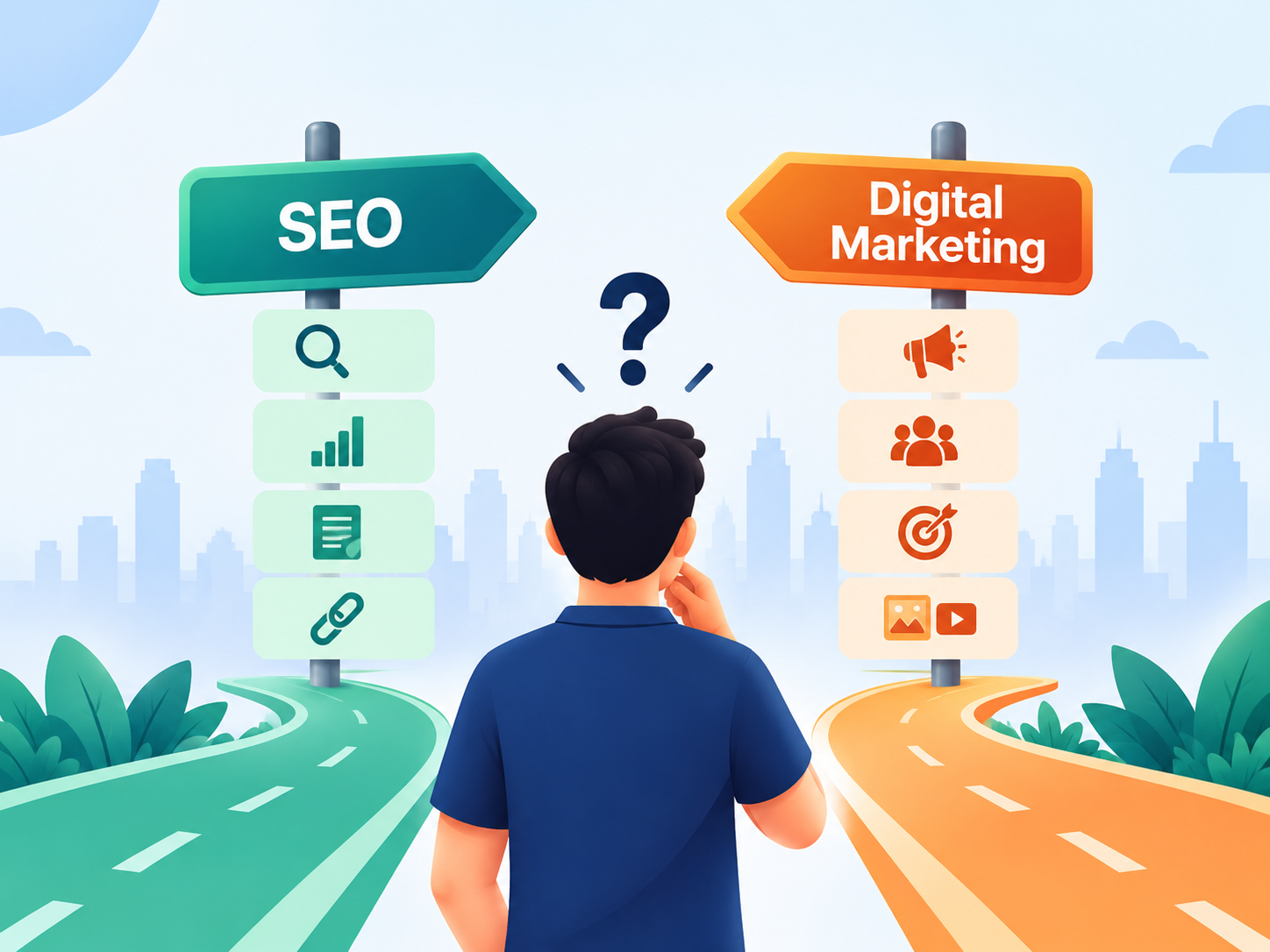
Two of the most common ways to capture that demand are SEO and Google Ads both part of a broader digital marketing strategy businesses use to grow online.
But if your marketing budget is limited, should you put it into improving your organic rankings or paying for search advertisements?
The answer depends on what you are trying to achieve.
A local service provider looking for enquiries this month may have different priorities from an established company trying to build search visibility across hundreds of topics. Your industry, competition, website, budget, sales cycle, and growth plans all influence the decision.
SEO and Google Ads Work Differently
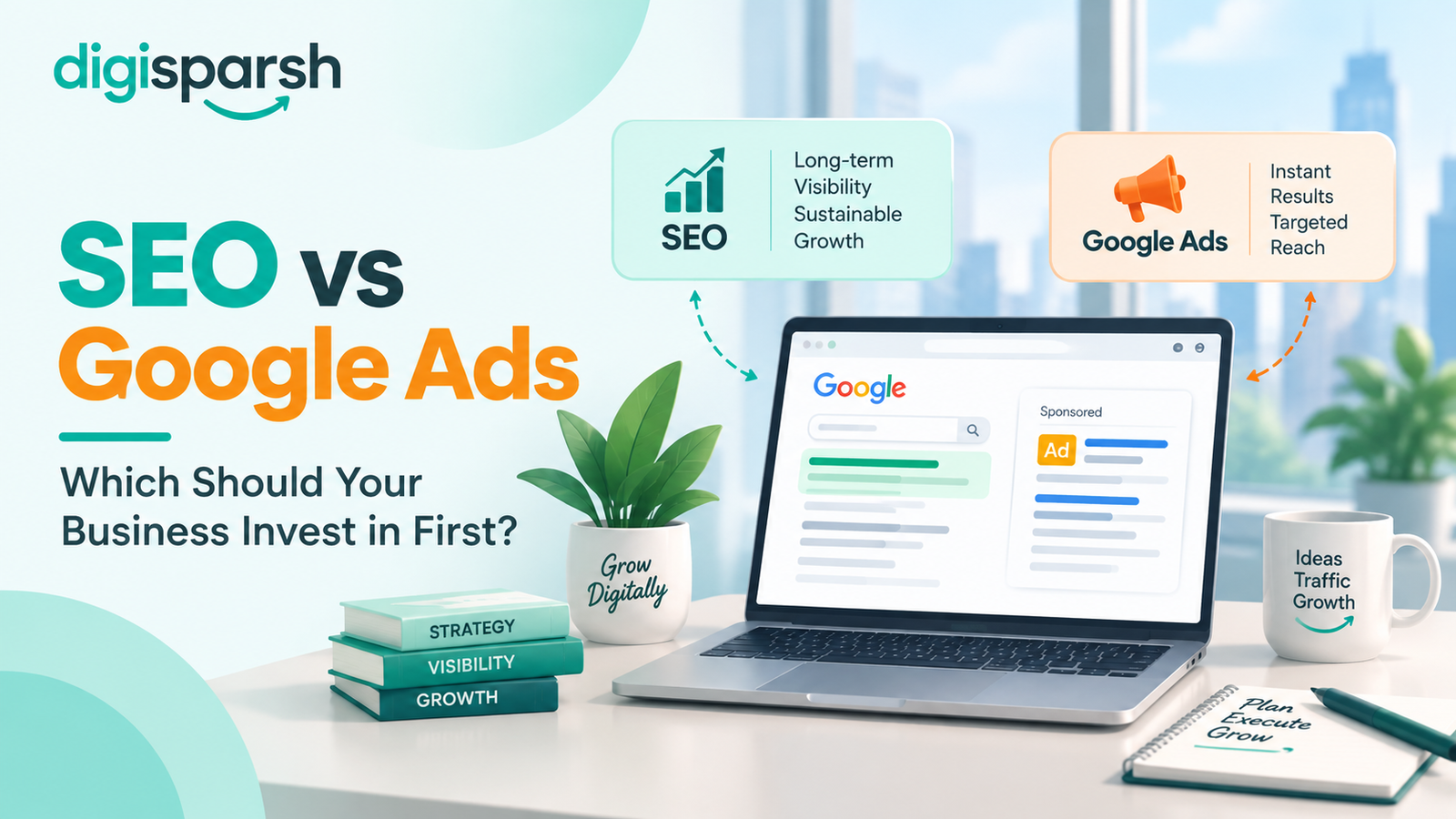
Although both appear around Google searches, SEO and Google Ads operate on different principles.
SEO improves the ability of your website to earn organic visibility in search results. It involves work across your website, including technical performance, page structure, content, search intent, internal linking, local signals, and other factors that influence how search engines understand and evaluate your pages.
Google Ads places paid advertisements in front of users based on campaign settings such as keywords, location, audience, budget, bidding strategy, and other targeting signals. Working with SEO and PPC experts can help you get both approaches right from the start.
If you’re also trying to understand how SEO fits within the wider marketing picture, our earlier post on SEO vs digital marketing breaks down that distinction in more detail.
Think of the difference this way:
With SEO, you are building your position in the search landscape.
With Google Ads, you are paying for a position that matches your campaign targeting.
Both can be useful, but they require different approaches.
What Does SEO Bring to a Business?
SEO is not simply about getting a website to rank for a handful of keywords.
A well-planned SEO strategy can help a business become visible across a wider range of searches related to its products, services, locations, expertise, and customer questions.
Consider a company that provides commercial interior design services.
Instead of targeting only “interior designer,” its website could potentially attract searches related to:
- Commercial interior design
- Office interior design
- Corporate office design
- Retail interior design
- Workspace planning
- Interior design ideas for offices
- Commercial interior design costs
Each search represents a different opportunity to connect with a potential customer.
That is where SEO becomes more than a ranking exercise. It can help a business build a search presence around an entire area of expertise.
SEO Can Help You Build Search Visibility Over Time
One useful characteristic of SEO is that improvements made to your website can continue to contribute to organic visibility after the initial work is completed.
A useful service page, well-structured location page, detailed guide, or genuinely helpful article can continue attracting relevant searches as long as it remains competitive and useful.
However, that does not mean SEO is passive.
Search results change. Competitors publish new content. Search behaviour evolves. Websites need technical maintenance. Existing pages may need to be updated.
SEO is therefore an ongoing process rather than a one-time website task.
What Does Google Ads Bring to a Business?
Google Ads takes a different route.
Instead of waiting for a webpage to earn an organic position, a business can create an advertising campaign designed to reach specific searches and audiences.
Imagine a company that has just launched a new service and wants to generate enquiries immediately.
Rather than waiting for its new service page to establish organic visibility, the company can create a Google Ads campaign and direct relevant searchers to a dedicated landing page.
This makes paid search particularly useful in situations where timing matters.
Google Ads can also give businesses considerable control over campaign variables such as:
- Daily or monthly budget
- Geographic targeting
- Search terms and keywords
- Ad messaging
- Landing pages
- Bidding strategies
- Campaign schedules
- Audience settings
But that control comes with a cost. Advertising requires an ongoing budget, and campaign performance needs regular monitoring.
SEO vs Google Ads: What Changes for Your Business?
The difference becomes clearer when you look at the business problem each channel is solving.
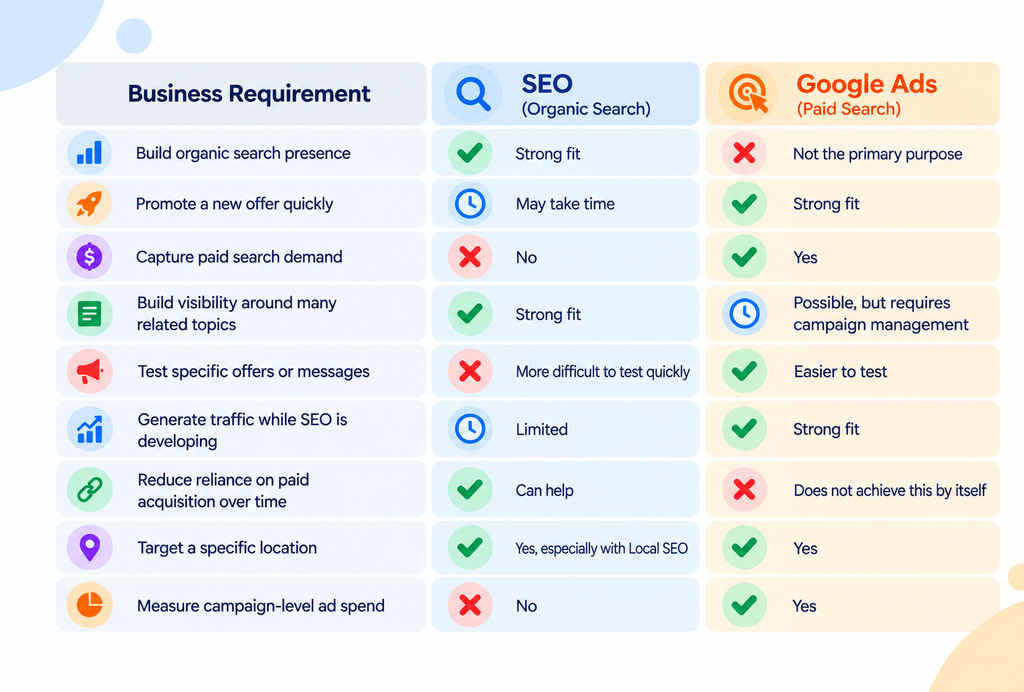
The table is not about declaring one channel the winner.
It is about understanding where each one fits.
When SEO May Be the Right Starting Point
SEO can be a logical starting point when your business is interested in building visibility that compounds through multiple pages, topics, and search queries.
Your Customers Research Before Contacting You
Some purchases happen after considerable research.
A potential customer may compare providers, read guides, check pricing information, look at examples, and search for answers before making contact.
SEO allows your business to become visible during these different stages.
For example, a B2B software company may want to appear not only when someone searches for its product category, but also when potential customers search for comparisons, implementation advice, features, costs, and solutions to related problems.
You Have Multiple Services to Promote
Suppose an agency offers:
- SEO
- Google Ads
- Social Media Marketing
- Website Development
- Content Marketing
- AI SEO
Creating individual, well-optimized service pages allows the business to build visibility around different commercial searches rather than sending every visitor to one generic page.
This is one reason SEO can become increasingly valuable as a business expands its range of digital marketing services.
You Want to Build an Organic Acquisition Channel
Businesses often depend heavily on referrals, social media, marketplaces, or paid advertising.
SEO agency can add another acquisition channel.
The objective is not necessarily to replace every other marketing activity. Instead, it can help diversify how potential customers discover the business.
When Google Ads May Make More Sense
Paid search can be particularly useful when the business has a clear offer and wants to put that offer in front of relevant searchers without waiting for organic visibility to develop.
You Need Enquiries for a New Service
Launching a new service does not automatically mean that your website will rank for related searches.
Google Ads can help bridge that gap while the business works on its organic strategy.
You Operate in a Highly Competitive Search Market
Some industries have established websites competing for important commercial keywords.
Building organic visibility in such markets can require substantial time and resources.
Paid campaigns provide another route to visibility while the business continues improving its organic presence.
You Have a Strong Landing Page
Advertising can bring people to your website, but traffic alone does not create customers.
Before investing heavily in Google Ads, check whether your landing page gives visitors a clear reason to enquire or purchase.
The page should make it easy to understand:
- What you offer
- Who the service is for
- Why the visitor should consider you
- What action they should take next
A campaign cannot completely compensate for a weak conversion experience.
What About Businesses With a Limited Marketing Budget?
This is where the decision becomes more practical.
Instead of dividing your budget automatically between SEO and Google Ads, identify the immediate business requirement.
Suppose you run a local dental clinic and need more appointment enquiries within the next few weeks. Paid search could be considered for high-intent searches while the website’s local and organic visibility is developed.
Now consider a B2B manufacturer with a long sales cycle. Its customers may spend weeks researching suppliers before speaking with a sales team. Building detailed service pages, industry content, product information, and organic search visibility could play a larger role in the acquisition process.
The two businesses have different customer journeys, so their search strategies should not look identical.
Can SEO and Google Ads Be Used Together?
Absolutely.
In many cases, the two channels can complement each other.
A business could use paid campaigns to capture demand for important commercial searches while simultaneously improving its organic rankings for those services.
There is another advantage to running both: you can learn from the search behaviour generated through your campaigns.
For example, paid search data may reveal:
- Which search terms attract relevant visitors
- Which messages generate engagement
- Which services receive the strongest demand
- Which locations perform better
- Which landing pages produce enquiries
These insights can help inform broader marketing decisions.
At the same time, SEO can expand the number of searches for which your business is discoverable organically.
Should You Stop SEO Once Google Ads Generates Leads?
The same principle applies to SEO.
If Google Ads is generating enquiries, that does not mean organic visibility is no longer valuable.
Paid campaigns depend on advertising budgets and campaign performance. SEO can continue building the website’s ability to attract people through unpaid search results.
A business that invests only in paid traffic may miss opportunities to build a broader organic search presence.
How Should You Decide Where to Invest First?
Before choosing a channel, look at five areas.
1. Your Business Goal
Are you trying to generate enquiries now, launch a new service, increase online sales, build brand visibility, or establish long-term organic traffic? Your goal should influence the channel you prioritize.
2. Your Customer Journey
Do customers make decisions quickly, or do they research for weeks? The longer and more information-heavy the buying journey, the more valuable a broader search presence can become.
3. Your Existing Website
A website with strong technical foundations, useful content, clear service pages, and good conversion paths gives you a stronger foundation for both SEO and paid traffic.
4. Your Competition
Look at the search results before deciding. Who is ranking organically? Who is advertising? What type of pages are appearing? What questions are competitors answering? Understanding the existing search landscape can reveal how difficult it may be to compete.
5. Your Available Budget and Timeline
A business with a short lead-generation window may allocate more resources toward paid campaigns. A business building a long-term acquisition channel may prioritize SEO. Many businesses can also create a combination based on their available resources.
A Practical Search Strategy for Businesses
Instead of treating SEO and Google Ads as competing options, businesses can assign each channel a specific role.
For example:
- Google Ads: Capture valuable commercial searches and support immediate campaigns.
- SEO: Build service pages, location pages, educational content, and topical authority.
- Conversion Optimization: Improve the pages receiving traffic from both channels.
- Analytics: Measure enquiries, sales, qualified leads, acquisition costs, and revenue.
This creates a complete search marketing strategy.
The focus shifts from simply asking, “How much traffic did we get?” to asking, “Did our search visibility contribute to business growth?”
SEO vs Google Ads: Which One Should You Invest in First?
There is no universal starting point.
If your priority is capturing demand around a time-sensitive offer or generating enquiries quickly, Google Ads may deserve attention.
If your priority is building organic visibility across services, topics, and customer searches, SEO may deserve greater investment.
And if search is an important acquisition channel for your business, using both can be worth considering.
The decision should ultimately come down to your business objectives, customer journey, search competition, website readiness, budget, and expected return.
SEO and Google Ads are not identical alternatives. They are two different ways of reaching people through search.
The strongest strategy is the one that connects the right channel to the right business objective. If you’d like help figuring out where to start, you can talk to our digital marketing team.
Frequently Asked Questions
How long does it take for SEO to yield results?
Timelines for SEO differ greatly. The speed at which rankings and organic traffic fluctuate can be influenced by a number of factors, including website history, technical state, competition, content quality, authority, search demand, and the extent of optimization.
Is it possible for a small business to use Google Ads and SEO together?
Indeed. While building organic visibility through SEO, a small business can use Google Ads for specific high-intent searches. The right balance is determined by performance, business goals, and budget.
Are organic rankings enhanced by Google Ads?
Organic rankings and Google Ads are two different systems. Higher organic rankings are neither directly purchased nor assured by running search ads.
Which is better for a new website: Google Ads or SEO?
Depending on its objectives and available resources, a new website may make use of both. While the SEO foundation for the website is being developed, Google Ads can help create visibility. Technical SEO, helpful content, and well-organized service pages can all lay the groundwork for future organic visibility.