Search is changing rapidly. Its now about AEO vs Traditional SEO – for years, businesses focused primarily on search engine optimization (SEO) to improve rankings, drive organic traffic, and increase online visibility. While SEO remains essential, the emergence of AI-powered search experiences is introducing a new layer of optimization – Answer Engine Optimization (AEO).
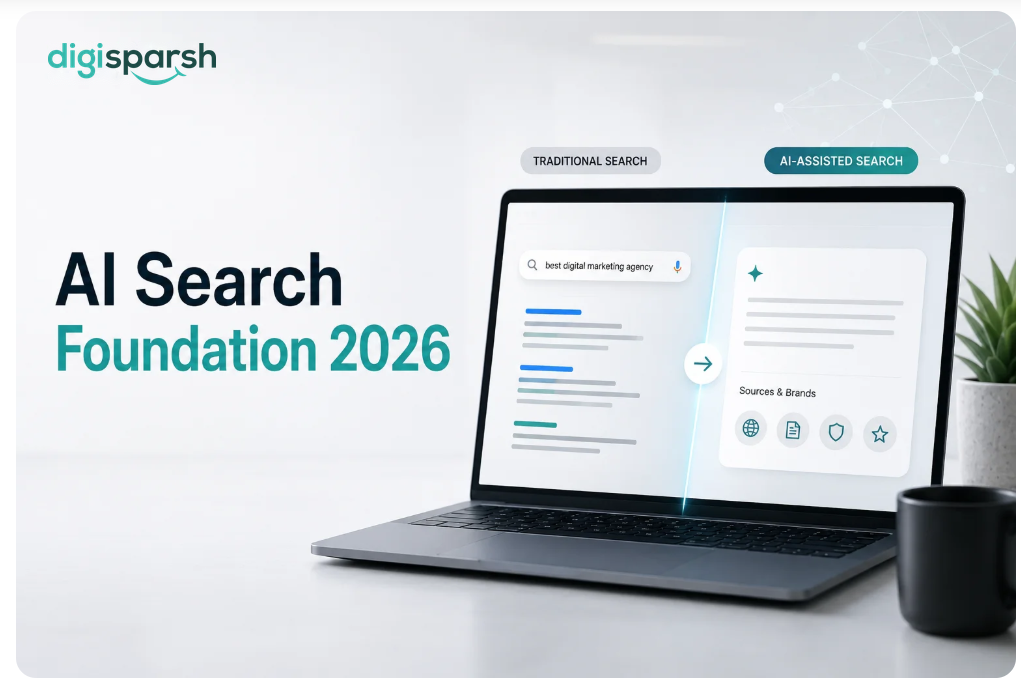
Today, users are increasingly receiving direct answers from Google AI Overviews, ChatGPT, voice assistants, and other AI-driven platforms instead of clicking through multiple search results.
More users are now interacting with AI-generated answers before visiting websites, reshaping how businesses approach online visibility.
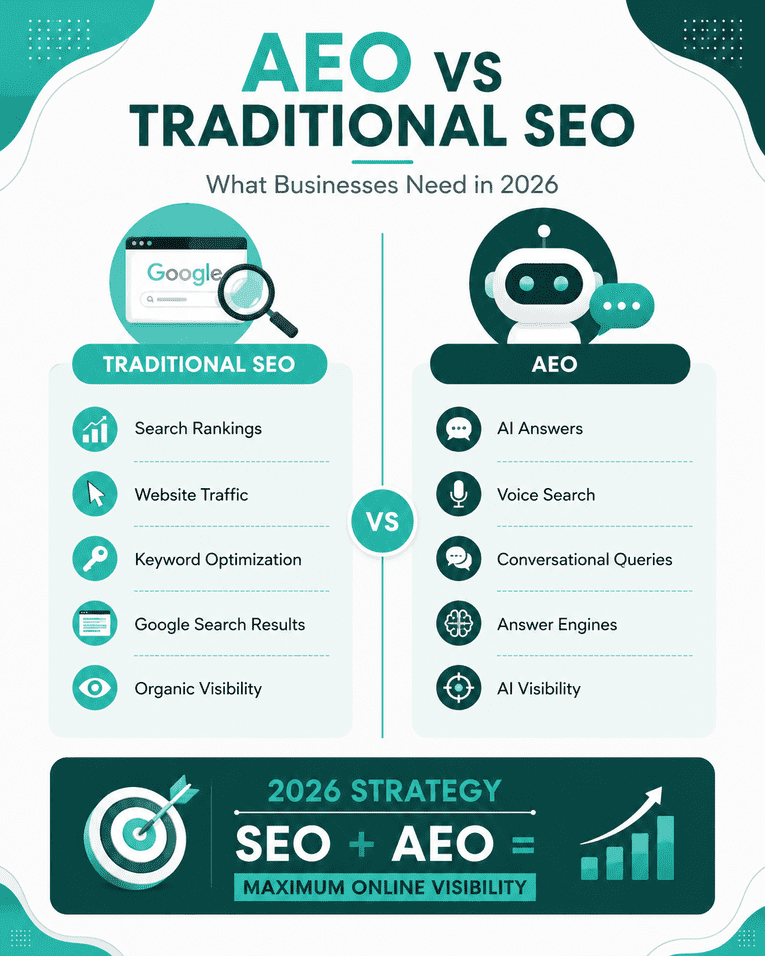
This shift has created an important question for businesses: Should they focus on traditional SEO, AEO, or both?
The answer lies in understanding how these two strategies work together and what they mean for digital growth in 2026.
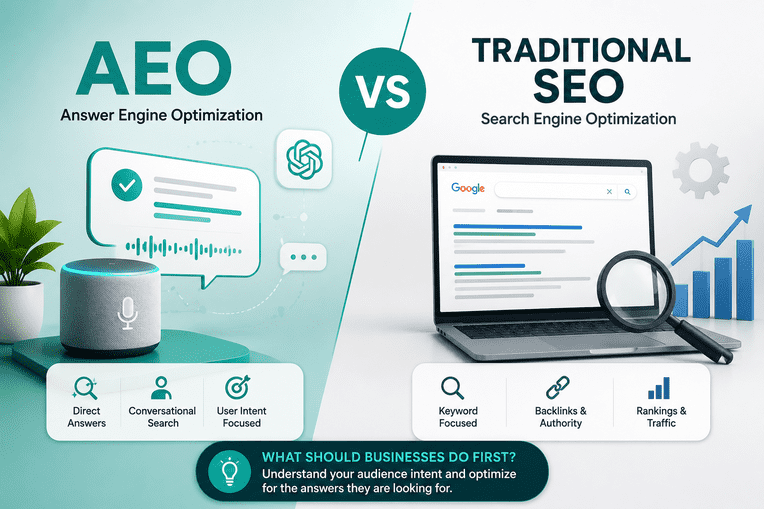
Understanding the Purpose of AEO vs Traditional SEO
Although they are closely related, SEO and AEO are designed to achieve slightly different goals.
Traditional SEO Focuses On:
- Improving search engine rankings
- Increasing organic website traffic
- Optimizing keywords and webpages
- Building authority through content and backlinks
The primary objective is to help webpages appear higher in search engine results.
AEO Focuses On:
- Delivering direct answers to user queries
- Improving visibility in AI-generated responses
- Optimizing content for conversational search
- Structuring information for answer engines
Instead of competing only for rankings, AEO aims to help businesses become part of the answer itself.
How User Search Behavior Is Evolving
Search behavior in 2026 looks very different compared to just a few years ago.
Instead of typing short phrases such as:
“best ecommerce platform”
users now ask:
“Which ecommerce platform is best for a growing business with SEO goals?”
AI systems analyze these conversational queries and generate summarized answers.
Traditional SEO Supports:
- Keyword-driven searches
- Organic search visibility
- Website traffic acquisition
AEO Supports:
- Conversational queries
- Voice search interactions
- AI-generated answer visibility
This shift is one reason businesses are increasingly investing in professional AEO services alongside traditional SEO campaigns.
Content Strategy Has Changed
Content remains the foundation of both SEO and AEO, but the optimization approach differs.
SEO Content Typically Prioritizes:
- Target keywords
- Search intent
- Internal linking
- Ranking opportunities
The goal is to improve visibility within search engine result pages.
AEO Content Prioritizes:
- Question-based content
- Clear answers
- Structured information
- Contextual relevance
Businesses working with DigiSparsh are increasingly combining both approaches to create content that performs well in search results while also being easily understood by AI-powered platforms.
Visibility vs Rankings – Understanding the Difference
One of the biggest distinctions between SEO and AEO is how success is measured.
Traditional SEO Success Often Looks Like:
- Higher keyword rankings
- Increased organic traffic
- Better SERP visibility
AEO Success Often Looks Like:
- Inclusion in AI-generated summaries
- Featured answer visibility
- Voice search presence
- Brand mentions in conversational AI platforms
A website may rank well on Google but still miss opportunities to appear in AI-generated responses if content is not optimized for answer-based discovery.
Why Structured Content Matters More Than Ever
AI systems rely heavily on content structure when identifying relevant answers.
Strong AEO Content Often Includes:
- Clear headings
- Direct answers
- FAQ sections
- Logical information hierarchy
Strong SEO Content Often Includes:
- Keyword optimization
- Metadata improvements
- Technical SEO enhancements
- Internal linking strategies
This is why many businesses now view AEO services as a natural extension of their SEO efforts rather than a replacement.
The Growing Role of Voice Search
Voice search continues to influence how users find information online.
People naturally speak differently than they type. Voice searches tend to be:
- Longer
- More conversational
- Question-focused
Traditional SEO helps websites rank for these searches, while AEO helps businesses become the direct answer provided by voice assistants and AI platforms.
As voice adoption continues growing, businesses that optimize for conversational queries may gain a competitive advantage.
SEO and AEO Work Better Together
A common misconception is that businesses must choose between SEO and AEO.
In reality, the strongest digital strategies combine both.
SEO Helps Businesses:
- Build authority
- Drive traffic
- Improve rankings
- Strengthen organic visibility
AEO Helps Businesses:
- Adapt to AI-powered search
- Improve answer visibility
- Reach conversational search users
- Increase brand discoverability
At DigiSparsh, we see AEO as the next evolution of search optimization rather than a replacement for traditional SEO. Businesses that invest in both strategies are often better prepared for changing search behaviors.
Quick Comparison – SEO vs AEO
| Factor | Traditional SEO | AEO |
| Primary Goal | Improve rankings | Deliver direct answers |
| Focus Area | Search engines | Answer engines & AI platforms |
| Content Style | Keyword-focused | Question-focused |
| User Intent | Search discovery | Immediate answers |
| Success Metric | Traffic & rankings | Answer visibility |
| Search Format | SERPs | AI-generated responses |
| Voice Search Impact | Moderate | High |
| Future Relevance | Essential | Growing rapidly |
What Businesses Need in 2026
The future of search is becoming increasingly hybrid. Users still rely on search engines, but they are also turning to AI-powered platforms for faster and more personalized answers.
Businesses that continue investing only in rankings may miss emerging opportunities in answer-driven search experiences.
At the same time, focusing exclusively on AEO without strong SEO foundations can limit long-term visibility.
The most effective approach combines:
- Strong SEO fundamentals
- Structured content strategies
- Conversational optimization
- AI search readiness
This balanced strategy helps businesses remain visible regardless of how users choose to search.
Businesses that want to stay ahead of changing search trends are increasingly adopting a combined SEO and AEO approach. At DigiSparsh, we help organizations optimize their digital presence for both search rankings and AI-generated answers. From content structuring and technical SEO to answer-focused optimization, our strategies are designed to improve visibility across Google Search, AI Overviews, voice search, and conversational AI platforms, helping businesses reach customers wherever they search for information.
FAQs
What is the difference between SEO and AEO?
SEO focuses on improving search rankings, while AEO focuses on helping content appear as direct answers in AI-powered search experiences.
Does AEO replace traditional SEO?
No. AEO complements traditional SEO and works best when integrated into a broader search optimization strategy.
Why are businesses investing in AEO services?
Businesses are investing in aeo services to improve visibility in AI-generated answers, voice search results, and conversational search experiences.
Is SEO still important in 2026?
Yes. SEO remains essential for organic visibility, website traffic, and long-term authority building.
Can businesses use SEO and AEO together?
Absolutely. Combining SEO and AEO often provides the strongest visibility across both traditional and AI-powered search platforms.