
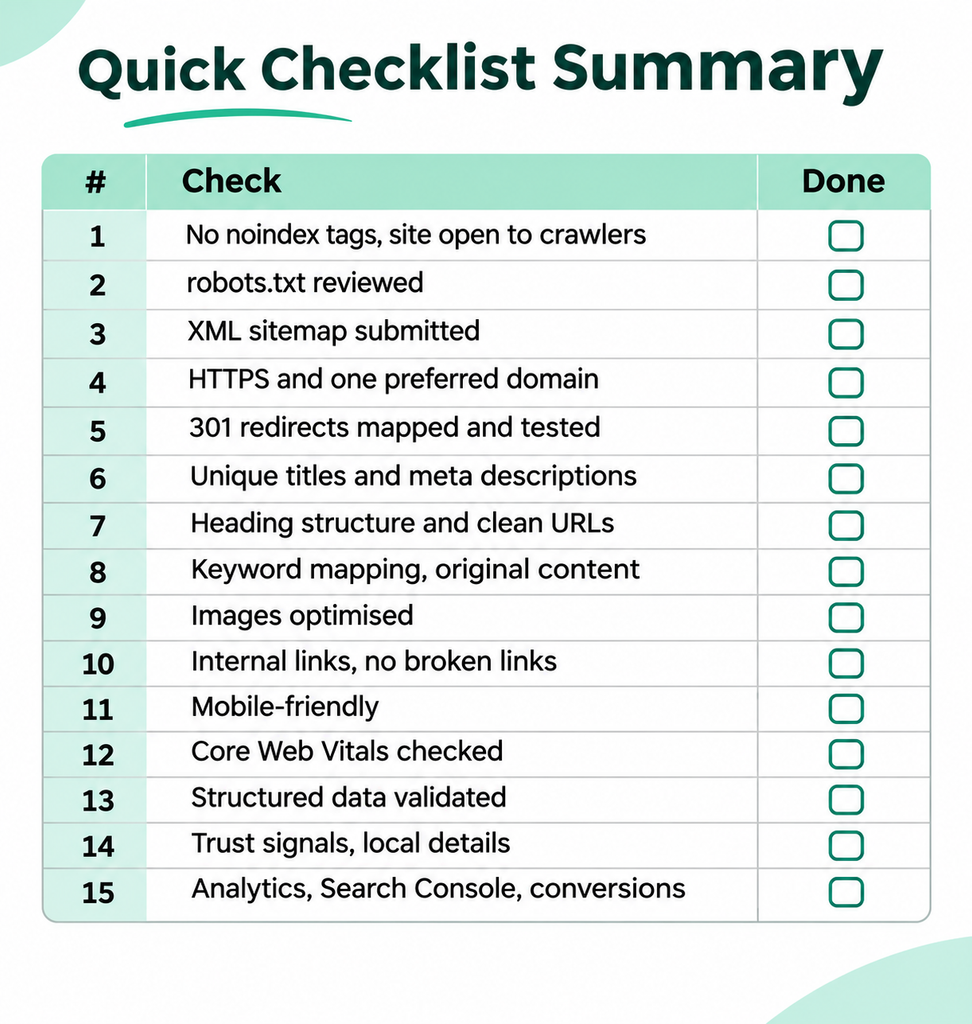
A new website is a big investment, and one small setting can hide it from Google. A common example is a noindex tag or a “discourage search engines” switch left on from the development stage. At DigiSparsh, we check for this and 14 other things before any site goes live. Here is the checklist we work through, why each item matters, and how our team handles it.
If you’d like us to run it on your site, our SEO services include a pre-launch review.
Key takeaways
- Most launch-day SEO problems are avoidable, and most come from staging settings, redirects, speed and missing tracking.
- Fix crawling and indexing first, then page-level basics, then speed, then trust and measurement.
- Run the checks on staging, then again within 24 hours of launch.
- A checklist prevents mistakes. It doesn’t promise rankings, which still depend on competition, content and time.
Part 1: Make sure Google can find and read your site
1. Remove noindex tags and open the site to crawlers
Staging sites are blocked on purpose, and it is easy to forget to unblock them. A single noindex tag can keep an entire site out of search results.
How we handle it: We check every key template and your platform settings before launch, and again right after it goes live.
2. Check robots.txt
The robots.txt file tells crawlers what they may visit. A leftover Disallow: / line blocks the whole site. Block only what truly shouldn’t be crawled, and add your sitemap location.
How we handle it: We review the file against your site structure and make sure nothing important is blocked.
3. Create and submit an XML sitemap
A sitemap lists the pages you want indexed. It should include only live, indexable, canonical URLs, with no redirects or error pages.
How we handle it: We generate a clean sitemap and submit it in Google Search Console and Bing Webmaster Tools.
4. Set up HTTPS and one preferred domain version
The site should load only over HTTPS, and every other version (http, www or non-www) should redirect to one. Mixed content should be fixed.
How we handle it: We check the domain versions, certificate and mixed-content warnings as part of our launch review.
5. Map and test your redirects
If this is a redesign or migration, every old URL should redirect to the closest new page with a 301, without chains, and not everything to the homepage.
How we handle it: We build a redirect map from your old site and test a sample before launch. Redirects are one of the biggest risks in a migration, so we treat them as a priority.
Part 2: Get the basics right on every page
6. Write unique title tags and meta descriptions
Every important page needs its own title tag with the main keyword and a meta description that gives a reason to click. Duplicate or empty ones are easy to catch with a crawling tool.
How we handle it: Our team writes them page by page, based on keyword research, so each page has a clear purpose in search.
7. Use a clear heading structure and clean URLs
Use one H1 per page, with H2 and H3 headings in a logical order, and URLs that are short, readable and consistent.
How we handle it: We review structure and URLs with your design and development team before pages are built, which is cheaper than changing them after launch.
8. Check keyword mapping and content quality
Assign one main topic to each page so your own pages don’t compete, and make sure each page answers what a visitor wants. Remove placeholder text and test pages.
How we handle it: We map keywords to pages, flag gaps and overlaps, and, if needed, our content team writes or edits the copy.
9. Optimise images
Compress images, use modern formats such as WebP where possible, add descriptive file names and alt text, set width and height, and lazy-load images below the fold.
How we handle it: We review image weight and alt text as part of the speed and on-page checks.
10. Build internal links and navigation
Important pages should be reachable within a few clicks, with descriptive anchor text. Fix broken links and orphan pages.
How we handle it: We plan the linking structure with your site map so your services, blog and key pages support each other.
Part 3: Speed, mobile and user experience
11. Test mobile-friendliness
Google predominantly uses the mobile version of a page for indexing, so the mobile site must contain the same content, links and structured data as the desktop one.
How we handle it: We test key pages on real mobile screens, not only in a desktop preview.
12. Pass Core Web Vitals
Google’s published “good” thresholds are Largest Contentful Paint within 2.5 seconds, Interaction to Next Paint of 200 milliseconds or less, and Cumulative Layout Shift of 0.1 or less.
How we handle it: Speed starts with how a site is built. Because DigiSparsh also designs and builds sites, our website development and e-commerce website development teams can fix performance problems at the source, instead of only reporting them.
Part 4: Trust, structure and measurement
13. Add structured data (schema)
Structured data helps search engines understand your pages. Common types are Organization, LocalBusiness, Article, FAQPage and Product. Add only markup that matches visible content.
How we handle it: We choose the types that fit your pages and validate them before launch.
14. Add trust signals and set up local details
Include a clear About page, contact details, a privacy policy and named authors for blog content. Keep your business details consistent across your site and profiles. These signals support E-E-A-T, though they are not a single ranking switch.
How we handle it: We review your trust pages and business details, and help set up local profiles where they apply.
15. Set up analytics, Search Console and conversion tracking
Install Google Analytics 4, verify the site in Google Search Console, and track form submissions, calls, WhatsApp clicks and purchases. Without tracking on launch day, you lose the first weeks of data.
How we handle it: We set up tracking before launch and test that each conversion is recorded.
What happens after launch
Launch isn’t the finish. Here is what we do in the first 30 days:
- Within 24 hours: check the sitemap status and request indexing for key pages.
- In week one: crawl the live site again for 404s, redirect issues and missing tags.
- Over the first month: watch indexing, Core Web Vitals and search queries, then improve pages that get impressions but few clicks.
- Ongoing: keep publishing useful content, with SEO and digital marketing support.
Why work with DigiSparsh on your launch
- One team, from design to search. Design, development and SEO sit together, so fixes are built, not only recommended.
- Checked before you go live. We review the site before launch, when changes are cheapest.
- Clear reporting. You see what we checked, what we fixed and what’s left.
- Honest scope. We tell you what SEO can and can’t do, and we don’t promise a ranking date.
Frequently asked questions
What is a pre-launch SEO checklist?
A list of technical, on-page and tracking checks completed before a site goes live, so search engines can crawl, index and understand it from day one.
When should SEO start on a new website?
During design and development. Changing structure, URLs and templates after launch costs more than planning them in advance.
How long does a new website take to rank?
There is no fixed time. It depends on competition, domain age, content quality and links. Indexing can take days to weeks, while competitive terms usually take months.
Can DigiSparsh review my site before launch?
Yes. Our SEO team can review your staging or live site against these checks and tell you what to fix first. Contact us to ask for a review.
Do you also build the website?
Yes. Our teams handle design, development and SEO, so the fixes from the review can be built by the same team.
Do you work with clients outside India?
Yes. We work with clients in India and international markets.
Launching a website soon?
Let our team check it before you go live. Request a pre-launch SEO review, or learn more about our SEO services.